Monopoly Railroads and Utilities: Are They Worth Buying?
Players who held all four railroads won 68% of 12,576 games, and FedEx out-earned every colour lot but two. Rent rules, real data and how to play them.
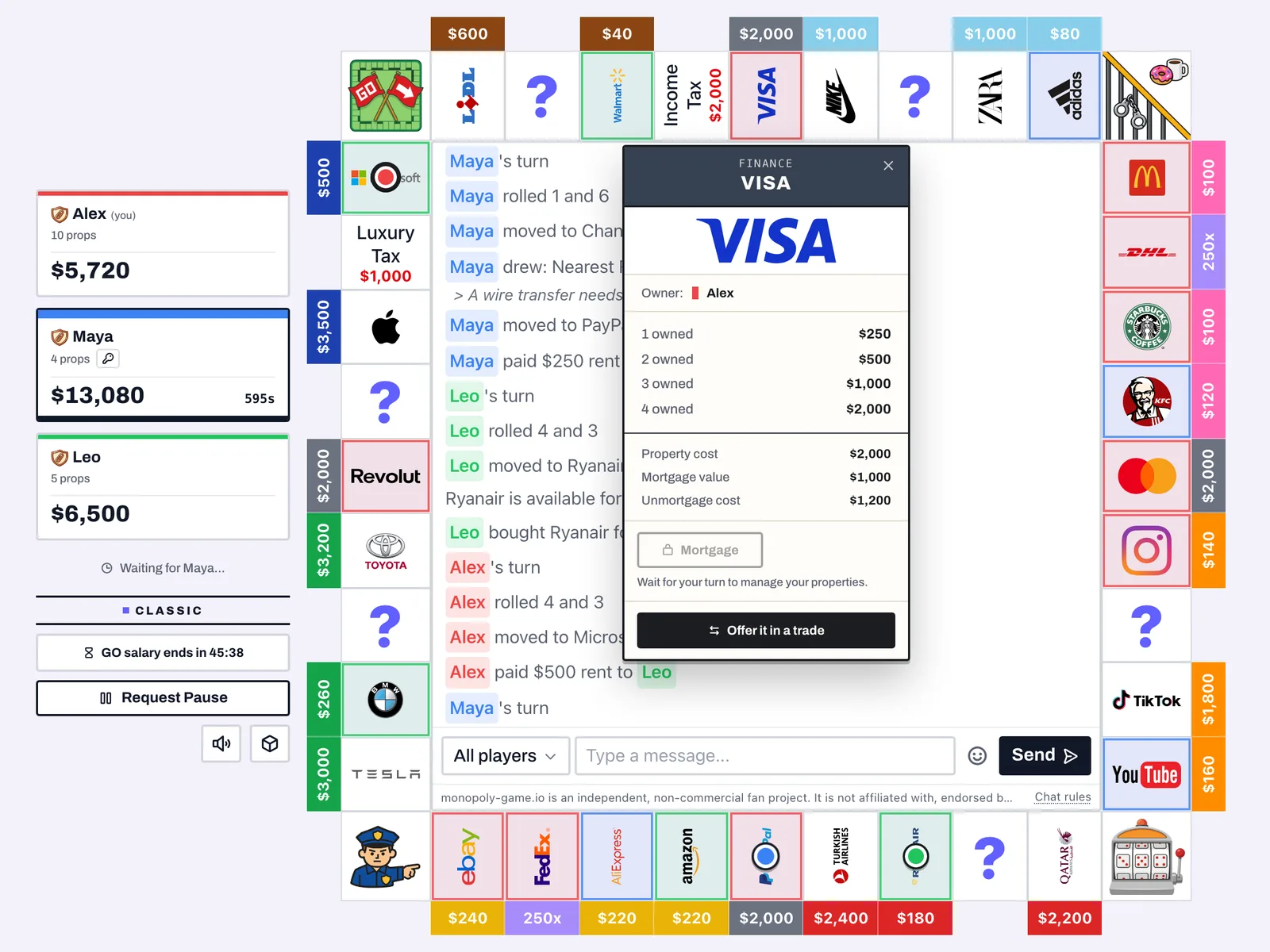
Yes, the railroads in Monopoly are worth buying, and the utilities are better than their reputation. In 12,576 finished classic games on Monopoly Online, players who held all four railroads won 68.3% of the time, at tables where an average seat wins 33.1%. And FedEx, a utility, out-earned every colour lot except Microsoft and Apple.
On our board the railroads are the Finance group (Visa, Mastercard, PayPal and Revolut) and the utilities are Industry (DHL and FedEx). Same squares, same jobs, real company names. Every number below comes from two months of those games, with each rent payment matched to the square where it happened.
How railroad rent works
Railroad rent depends only on how many of the four the owner holds. One charges 250, two charge 500 each, three charge 1,000 and all four charge 2,000. The dice don't matter, and you can't build on them. Each one costs 2,000.
| Railroads the owner holds | Rent per landing |
|---|---|
| 1 | 250 |
| 2 | 500 |
| 3 | 1,000 |
| 4 | 2,000 |
That's the box rule at our money scale: Hasbro's railroads cost $200 and charge $25, $50, $100 or $200. Every railroad you add doubles the rent on all of them, so the fourth is the big one. If each of your railroads gets landed on once, three earn you 3,000 and four earn you 8,000.
One detail changes the count. A mortgaged railroad stops counting for its owner, so four with one under mortgage charge the three-railroad rent of 1,000. The colour lots follow their own rules, and our rent rules guide covers every one of them.
How utility rent works
Utility rent is your dice total times 100 if the owner has one utility, or times 250 if they have both. Roll a 7 onto FedEx while its owner also holds DHL and you pay 1,750. A 12 costs 3,000, the biggest utility bill in our data. Each utility costs 1,500.
Here we left the box's maths on purpose. Hasbro's utilities charge 4 or 10 times the dice, which at our scale would be 40 or 100 times. Ours hit two and a half times harder.
The Chance cards work differently too. In the box, the card that sends you to the nearest railroad makes you pay double rent, and the utility card makes you pay ten times a fresh roll. On our board both cards just move you there and you pay the normal rent. For a utility, the dice you rolled to reach the Chance square set the bill.
Are railroads worth it? What 12,576 games say
The more railroads a player held, the more often they won. We took every player who was ever paid railroad rent and sorted them by the biggest bill they collected, which shows how many railroads they held at that moment.
| Most railroads held when paid | Players (one per game) | Won the game |
|---|---|---|
| 1 | 7,711 | 25.1% |
| 2 | 5,676 | 34.5% |
| 3 | 3,292 | 47.3% |
| 4 | 3,554 | 68.3% |
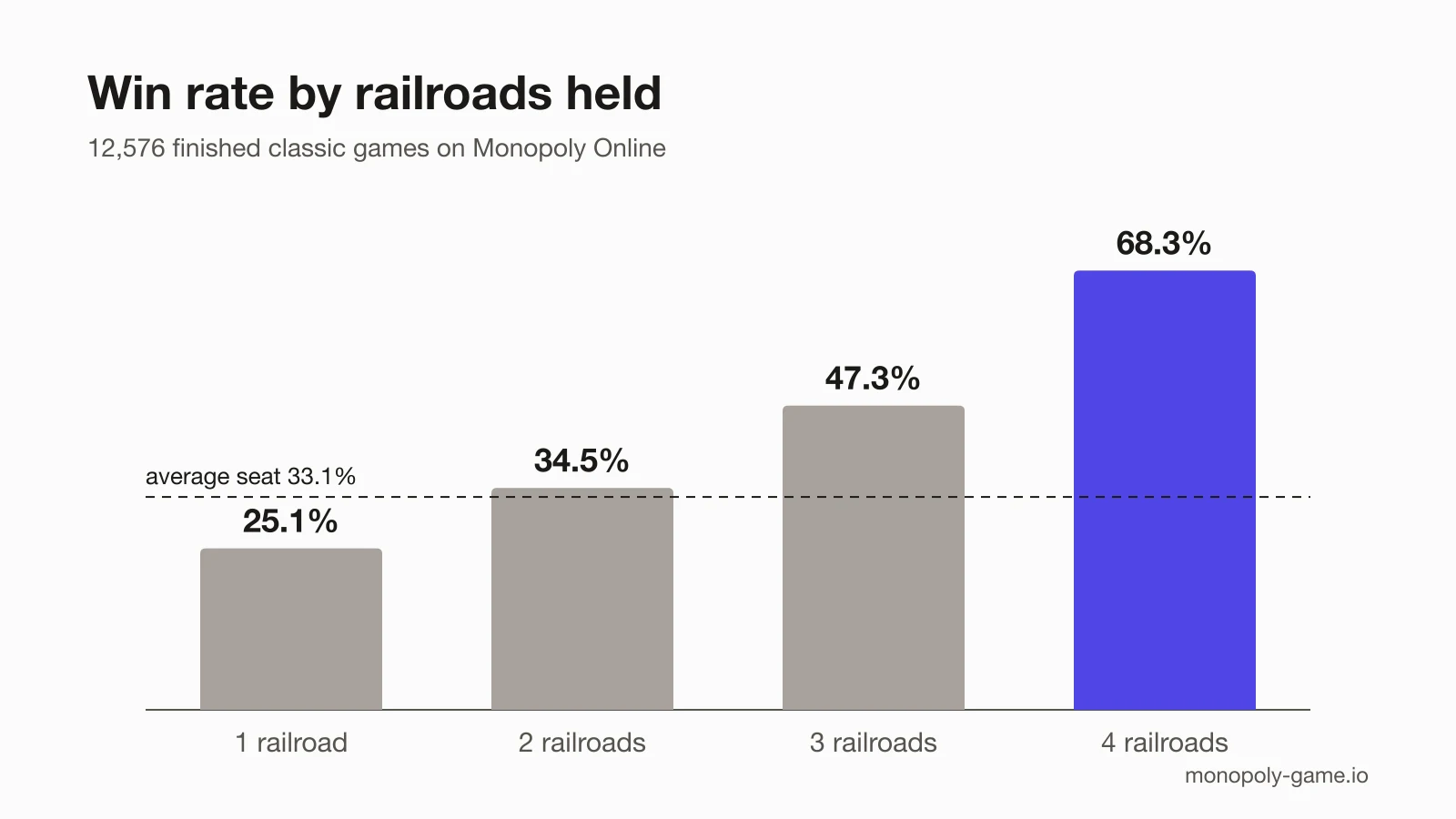
Tables averaged three seats, so a random player wins 33.1% of the time. One railroad sits below that line. Four is double it.
Read that as a link, not a proof. To collect a 2,000 bill you need all four deeds at once, none of them mortgaged, and you need to still be in the game when somebody lands. That describes a player who's usually ahead already. Part of the 68% is the railroads paying, and part of it is strong players being the ones who end up holding them.
We ran the same test on the colour sets, counting a player once a lot in their set charged full-set rent (double base rent, or houses). Yellow owners won 54.9%, dark blue 54.0%, orange 53.6%, and brown sat at the bottom with 45.6%. Don't read that as Finance beating Amazon head to head, because four deeds are a bigger share of the board than two or three. The part that holds without any caveat: someone collected the full Finance set in 3,420 of the 12,576 games, about one in four, and that player usually won.
Are utilities worth it?
On this board the utilities are the best value buy there is. FedEx earned its owners 2,381 in rent per game on average, third among all 28 buyable squares, behind only Microsoft (4,215) and Apple (2,998). DHL came sixth with 2,164. Both cost 1,500, and neither ever needs a house. Apple costs 3,500 before its first one.
Owning both is what makes them dangerous. Players who were paid at the two-utility rate at least once won 57.4% of their games. Players who only ever collected single-utility rent won 35.6%.
The old advice to skip the utilities comes from the box, where a 7 on one utility costs $28 and nobody notices. Here it costs 700, and with both it's 1,750. For how the colour groups stack up against each other, see our ranking of the best properties to buy.
Which earns more, railroads or utilities?
Square for square, utilities do. The four railroads earned between 1,339 (Visa) and 1,623 (PayPal) per game each, while DHL and FedEx earned 2,164 and 2,381. As a group, Finance brought in 5,880 per game against Industry's 4,545, but owning all of Finance costs 8,000 and all of Industry costs 3,000.
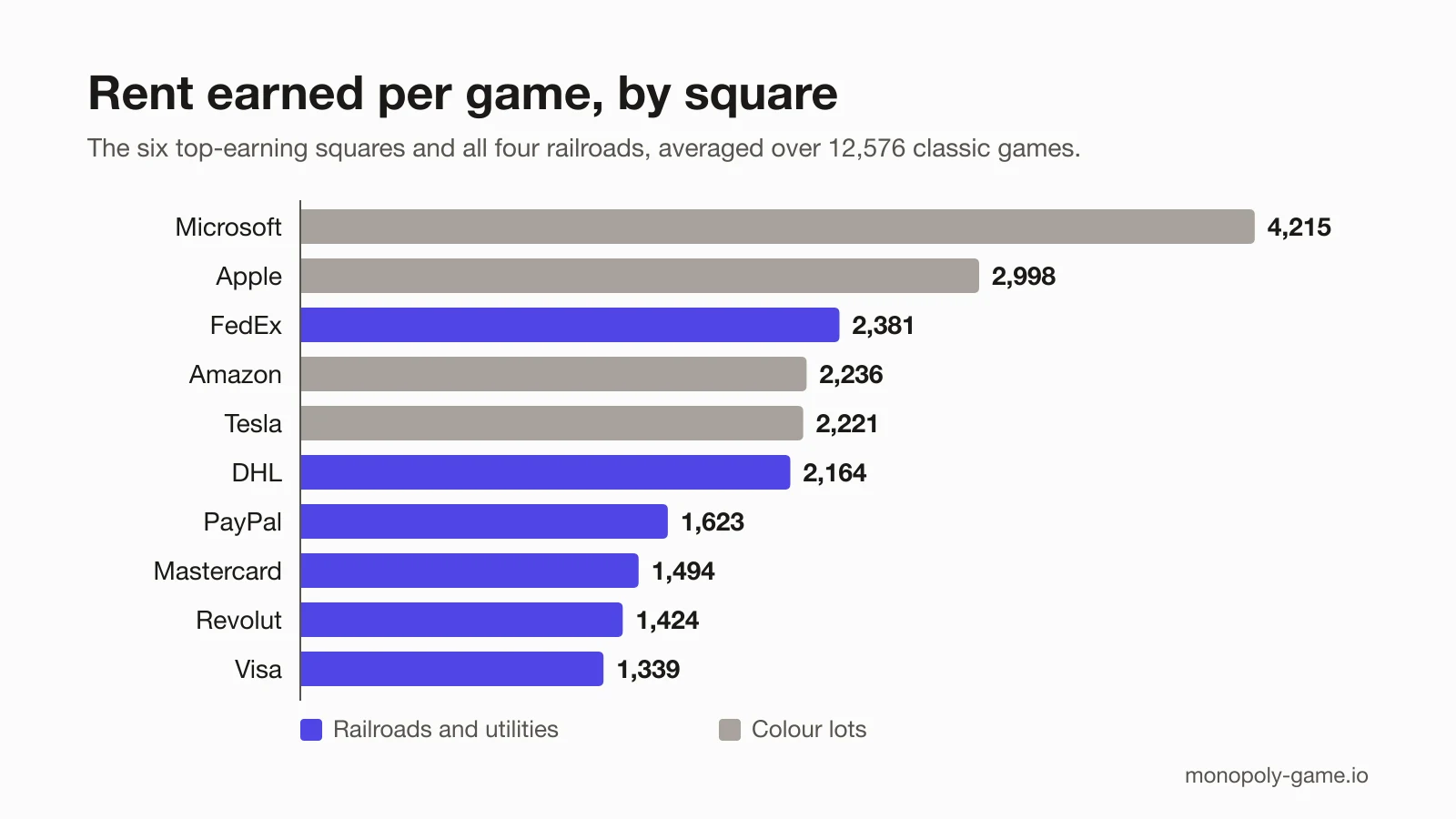
Of all the rent paid in those games, the four railroads collected 12.4% and the two utilities 9.6%. Two squares took almost as much as four.
PayPal is the busiest railroad. It was the sixth most landed-on buyable square in our games, while Visa came nineteenth, so if you only get one early, you'd rather it was PayPal.
How to play railroads and utilities
- Buy every railroad you land on in the opening. One is weak alone, but each one you hold makes the next worth twice as much, to you and to anyone trying to finish the set.
- Trade for the third and fourth. Nobody can build on a railroad, so no house ever locks one out of a deal. Our trading guide covers what makes an offer fair enough to send.
- Don't mortgage one of four for small money. It drops every railroad you own from 2,000 to 1,000 until you pay it off, and the mortgage rules give you seven rounds before the bank auctions it.
- Take both utilities whenever the price is near 1,500, and bid higher at auction if you already hold the other one.
- Pass only when the cash already has a job. If you hold a colour set and the money is what its houses need, the houses come first.
Do they still matter late in the game?
Yes, mostly because they never cost you anything after you buy them. In a classic game the GO salary stops at minute 46, and from minute 61 the bank keeps half of every rent payment, ten points more every five minutes, up to 99%. That tax takes the same cut from every square. What changes is your wallet. A hotel run needs thousands in building money right when cash runs dry, while a railroad or a utility keeps paying for nothing.
The rent calculator has the exact number for every square. Or open a table in the lobby and go after all four railroads: in one game out of four somebody gets them, and that player usually wins.
Related articles
1,152 Games in One Day: Monopoly Online Passes 1,000
On October 27 you started 1,152 games in a single day, our first day past 1,000. Here's who played, what you played and how fast it grew.
Monopoly Skins: How to Get the Exact Brand Skin You Want
Every way to get skins in Monopoly Online, none of them paid: cases from playing, Craft, trading and the Upgrader, with the real numbers behind the wheel.
Monopoly Rent Rules: How Rent Works, With Real Game Data
How much rent you pay on every space, what changes with a full set, a mortgage or jail, and what 229,194 real rent payments say about where the money comes from.